
The Grocery War in the U.S. — and Why Korea Will Be Won in 1–2 Hours

The grocery delivery war in the United States is entering a decisive phase.
The question is no longer whether online grocery will grow, but who can build a system that reliably delivers within 1–3 hours at scale.
Amazon has already expanded 3-hour grocery delivery to over 2,000 cities and towns across the U.S., with 1-hour delivery available in hundreds of locations. The assortment now exceeds 90,000 SKUs. Pricing is set at $9.99 for 1-hour delivery and $4.99 for 3-hour delivery for Prime members.
This is not simply about faster delivery.
It is an attempt to separate grocery consumption from the traditional next-day logistics model and rebuild it on a dedicated, real-time infrastructure layer.
Kroger Is Under the Most Structural Pressure
Among all players, Kroger is facing the most structural pressure.
Back in 2018, Kroger partnered with Ocado to build a network of 20 Customer Fulfillment Centers (CFCs) across the U.S. But as of 2026, only a limited number of facilities are operational or planned — in states like Ohio, Texas, Georgia, Colorado, Michigan, and one in Phoenix, Arizona.
Meanwhile, Walmart operates more than 4,700 stores across the U.S. and has already been leveraging this store network to process online grocery orders. Now, through its partnership with Symbotic, Walmart is deploying automation systems inside hundreds of stores to accelerate fulfillment.
The direction is clear:
Large centralized warehouses alone are no longer enough.
The competition is shifting toward:
store-proximate automation + fast delivery
Korea’s Grocery Market Is Split Into Three Structures
In Korea, the competitive landscape currently consists of three distinct models:
Urban supermarket-based delivery (e.g., Emart Everyday, GS The Fresh, Homeplus Express)
Platform-based delivery (Baemin grocery, convenience store delivery)
Dawn delivery models (Coupang Rocket Fresh, Kurly)
Demand is not the problem.
According to government data, online sales for major retailers grew 11.8% year-over-year in 2025. Food-related e-commerce transactions also increased by over 10%.
The real question is:
Which structure will absorb that demand?
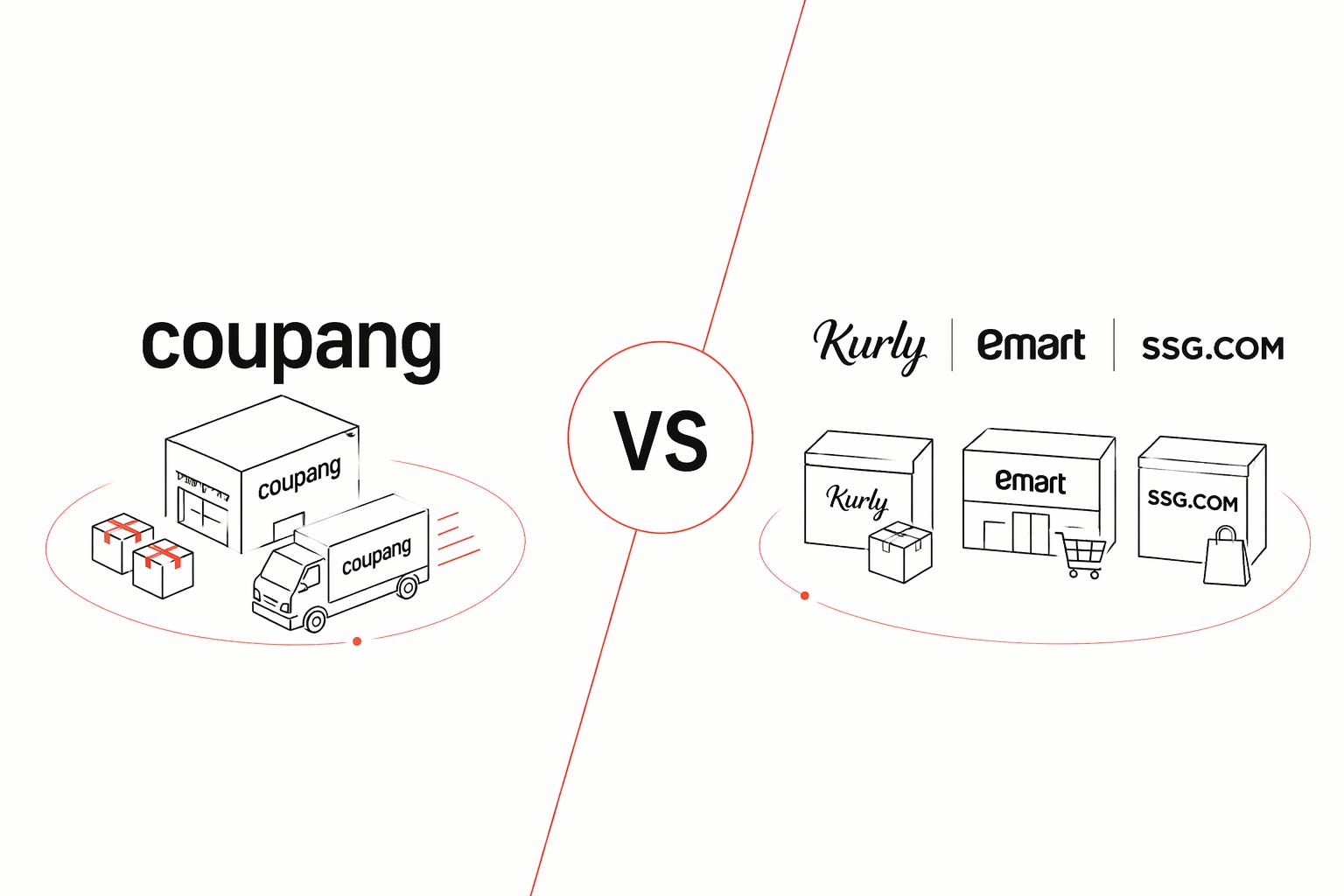
Coupang Is Already Operating on a Different Layer
This is where Korea diverges sharply from the U.S.
Coupang is not building this system — it already has much of it in place.
As of the end of 2025:
24.6 million active product commerce users
100+ logistics centers
Coverage across 30+ regions
$34.5B annual revenue
7.7% adjusted EBITDA margin in product commerce
In practical terms:
What U.S. companies are trying to build, Coupang has already assembled.
Because Korea is geographically compact, Coupang’s Rocket Fresh infrastructure effectively functions like a distributed CFC network, while its existing delivery network resembles the same 1–3 hour system Amazon is still expanding.
The Real Difference: Layer vs System
The most important difference is structural.
U.S. players are adding a new layer on top of existing retail systems.
Coupang, on the other hand, operates a fully integrated execution system.
Direct inventory ownership
In-house fulfillment
Integrated delivery
This means:
For Amazon, 1–3 hour delivery is a capex problem (build more nodes, more inventory, more routing flexibility)
For Coupang, it is primarily an operational problem
(how to reorganize inventory placement and time slots)
The starting lines are fundamentally different.
In Korea, the Real Battle Is 1–2 Hour Grocery
This leads to a critical insight.
The future of grocery in Korea is not quick commerce but 1–2 hour grocery delivery.
30-minute delivery relies on rider-based, single-order fulfillment — which is structurally expensive.
But 1–2 hour delivery can leverage:
existing vehicle networks
idle daytime logistics capacity
This makes it significantly more scalable and economically viable.
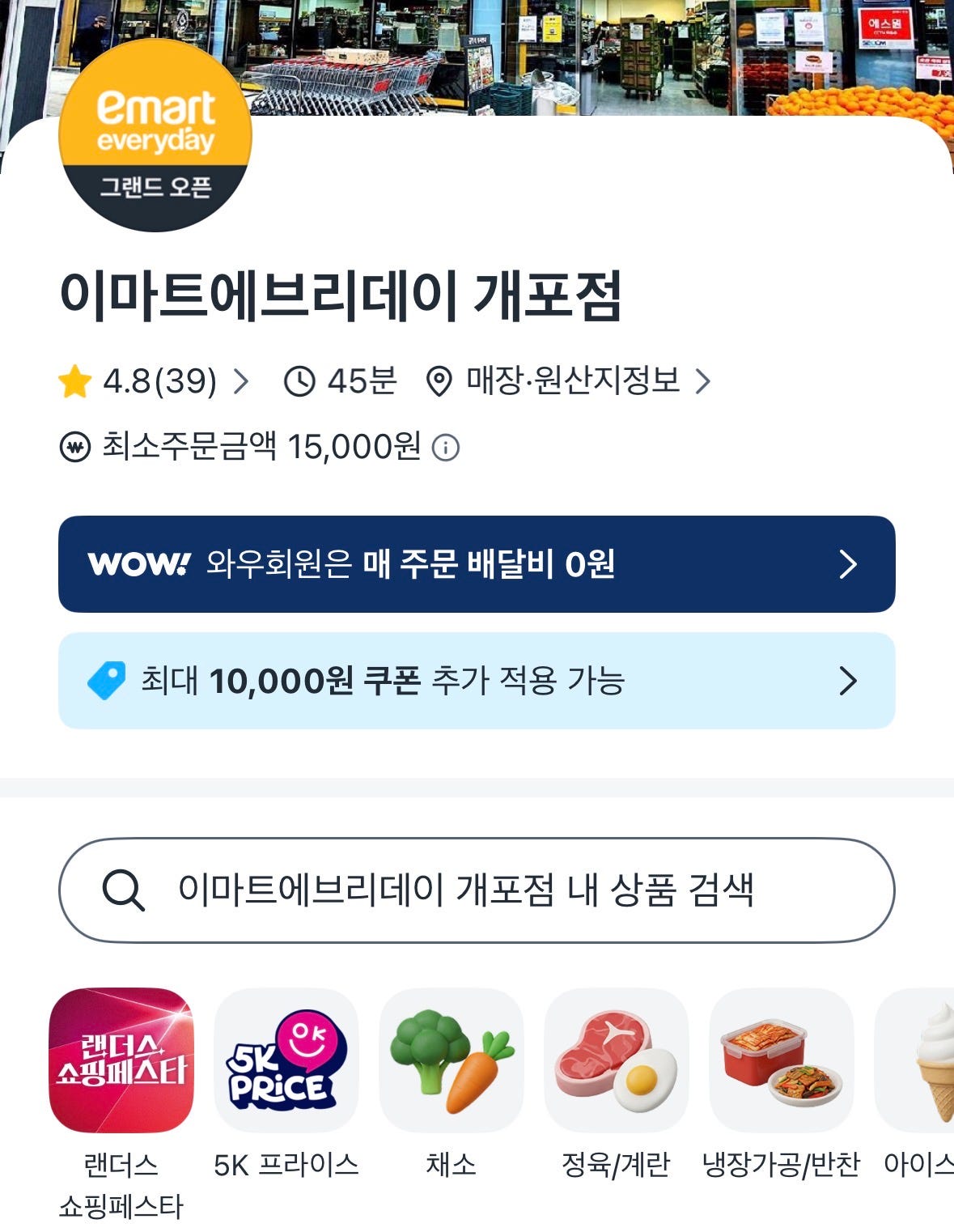
Coupang Is Already Preparing the System
Coupang’s recent moves provide a clear signal.
By onboarding external retail channels — such as convenience stores and supermarkets — into Coupang Eats grocery and shopping, it is not simply building a commission-based marketplace.
It is learning SKU demand patterns and building supply density.
For example, CU joined Coupang Eats Grocery in late 2025 with around 1,000 stores in Seoul.
At the same time, Coupang continues to aggressively subsidize demand through discounts for Wow members.
This is data acquisition and demand shaping.
1–2 Hour Grocery Changes Consumer Behavior
This is where the real disruption happens.
Until now, grocery consumption in Korea has been split between:
Immediate purchases (convenience stores, local supermarkets)
Next-day consumption (dawn delivery)
But 1–2 hour grocery introduces an entirely new behavior layer:
Ordering at lunch for dinner
Ordering before leaving work
Refilling ingredients during the weekend afternoon
This segment combines:
higher order value than quick commerce
stronger immediacy than dawn delivery
Once established, it becomes the core consumption loop.

The Structural Pressure on Kurly and Olive Young
The players most exposed to this shift are Kurly and Olive Young.
Kurly’s strength has historically been its time slot advantage (next-morning delivery), not exclusive SKUs.
Even with same-day options, the model largely redistributes demand across time rather than fundamentally improving convenience.
If Coupang establishes a reliable 1–2 hour grocery system, Kurly’s core loop — “order today, receive tomorrow morning” — comes under direct pressure.
This Is Not About Delivery — It’s About Control
The same applies to H&B retail.
Olive Young operates ~1,394 stores and offers same-day delivery within ~3 hours. Baemin has also scaled its grocery and shopping network significantly.
But these models rely on:
external store inventory
fragmented fulfillment
fixed SLA constraints
This leads to frequent stock issues and limited inventory depth.
Coupang operates differently:
centralized inventory control
integrated fulfillment
unified delivery + returns loop
The result is fundamentally different unit economics.
This is where the market changes.
Grocery stops being a delivery problem.
It becomes an execution system.