
Execution Theory: Power Is Shifting from Discovery to Execution
The internet era was defined by discovery. The agent commerce era may be defined by execution.

For the past two decades, e-commerce has largely been understood as a problem of discovery. Competition was defined by who could attract attention, organize choice, and convert demand more efficiently.
That interpretation was not wrong.
If power in offline retail was defined by location and channel, the internet shifted that power to search and discovery.
With mobile, the focus moved further toward faster checkout, higher frequency, and reduced friction.
But a new transition is now underway.
AI agent commerce.
The essence of this shift is not better recommendation.
It is the transfer of execution from humans to systems.
Where humans once searched, compared, and checked out, systems will increasingly interpret constraints, select products, and execute transactions.
At that point, the basis of platform power changes.
Not what gets shown first,
but how reliably a transaction can be completed end-to-end.
Humans fill gaps. Agents avoid them.
Humans can complete transactions even on imperfect systems.
They wait through delays, navigate unclear refund policies, and retry failed payments.
Humans fill the gaps in systems with judgment and tolerance.
Agents do not.
Agents do not get persuaded.
They calculate, confirm, and execute.
If the rules for completing a transaction are unclear, that path will not be selected.
If delivery is unreliable,
if refund logic is fragmented,
if responsibility is unclear,
the transaction may still be possible for a human, but it becomes an inefficient path for a system.
The principle is simple.
Humans fill gaps. Agents avoid them.
Commerce operates in three layers
Commerce operates across three core layers:
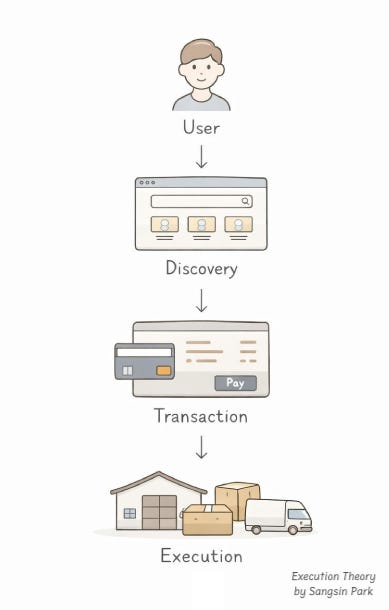
Discovery: what gets seen
Transaction: what gets committed
Execution: what gets fulfilled and resolved
These layers do not exist independently.
A transaction only closes when they connect end-to-end.
And in the agent era, the final layer becomes the most important.
Commerce is not complete when it is shown.
It is complete when it is executed.
Execution is not delivery. It is closure.
Execution is often misunderstood as delivery.
In reality, it is a broader system.
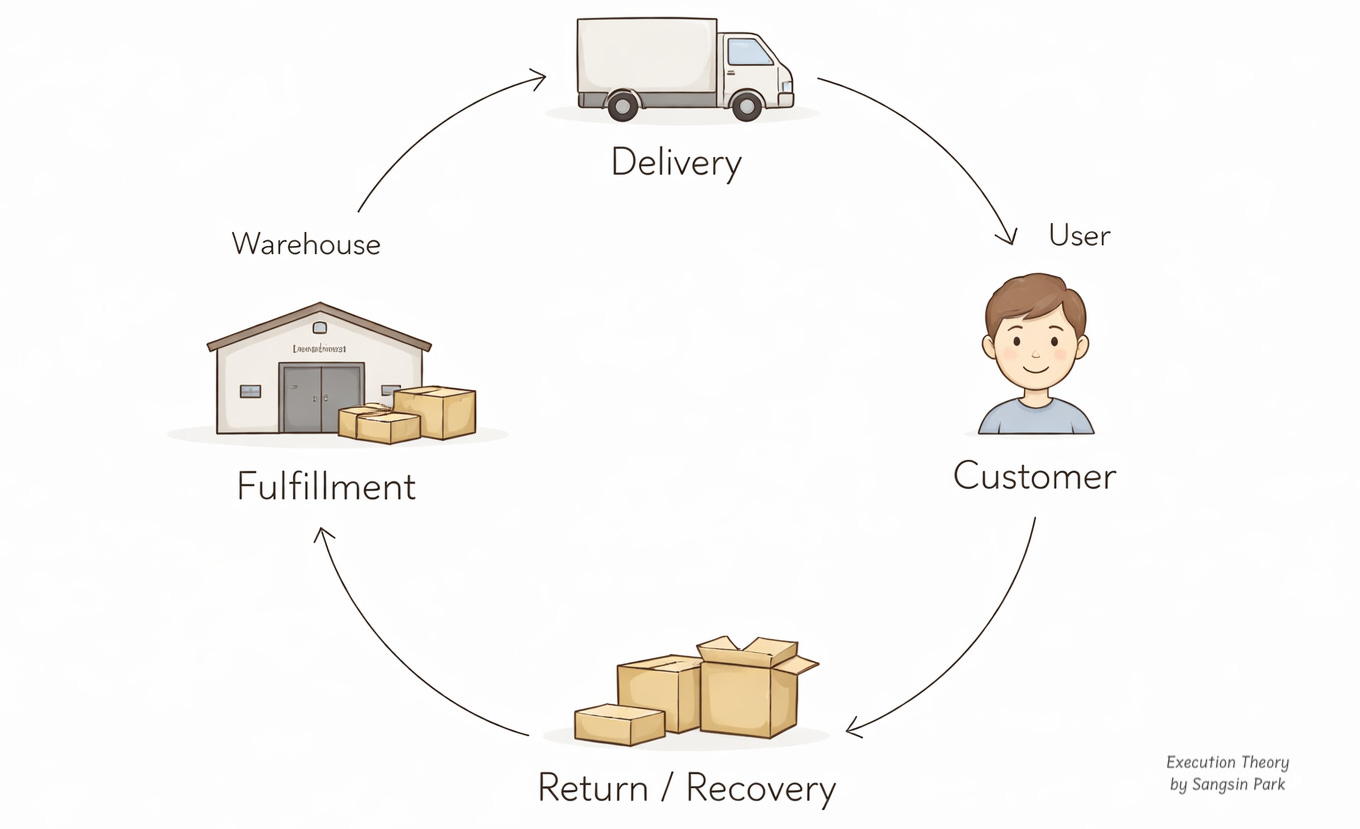
It consists of three stacks:
Fulfillment: inventory allocation, picking, packing
Delivery: transport, timing, SLA
Recovery: returns, refunds, exchanges, reconciliation
The point is not their existence.
It is whether they form a closed loop.
Speed does not close a transaction.
Recovery does.
Execution is not about speed. It is about closure.
What Execution Theory explains
Execution Theory is not a logistics theory.
It is a framework for understanding where platform power resides.
In the internet era, discovery was the dominant variable.
In the agent era, execution may become the dominant one.
The key questions shift:
Who controls post-order state transitions most deeply?
Who operates with fewer exceptions and stronger standards?
Who can recover failures within the same system?
Who can systematize repeat behavior?
Execution Theory asks not who shows more, but who completes more reliably.
This is not a single-winner model
The rise of execution does not imply a single dominant platform.
In some markets, discovery remains powerful, especially where taste and curation matter.
In others, execution reliability becomes an independent source of power.
Through this lens, structure becomes visible:
Coupang: deeply integrated execution
Naver: discovery-led power
Cafe24: distributed infrastructure
Vertical players: depth in specific domains
Execution Theory does not predict winners.
It explains where power sits.
Why now, and why Korea
Korea is one of the few markets that has already pushed execution density to an extreme.
High logistics density
Fast delivery
Mobile-native behavior
Advanced payment systems
But once transactions cross borders, these systems break.
And now, those constraints are being restructured.
Translation is no longer the bottleneck
Total cost becomes structured
Returns and recovery become competitive factors
Competition is shifting from domestic discovery to global execution.
The next phase of Korean commerce will be decided not at the interface, but in the execution layer.
Conclusion
The internet era was defined by discovery.
The next era may be defined by execution.
Discovery does not disappear.
But it is no longer sufficient.
The central question changes:
Not who shows more but who completes better.
From here, I will use Execution Theory to analyze Naver, Coupang, Olive Young, Kurly, and cross-border systems.
Technology does not just change interfaces.
It changes where power resides.
And in the next phase of commerce, that power may sit closer to execution than discovery.