
LA to Seoul in 72 Hours at $4: Why Korea Is Closer Than You Think
Cross-border commerce is becoming operationally local — and most U.S. brands haven't noticed

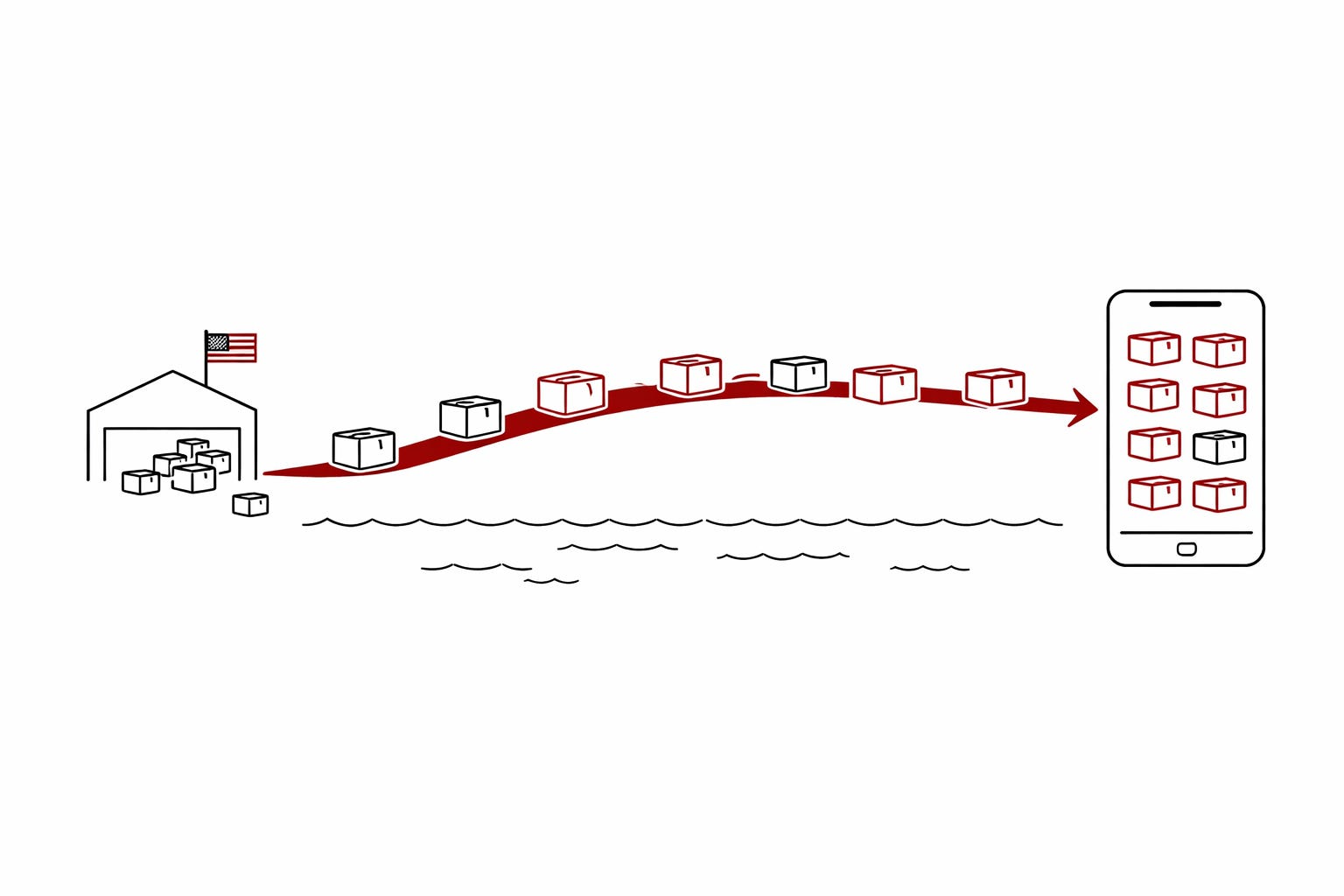
Ask a U.S. brand executive what it would take to sell into South Korea, and the answer usually sounds like a traditional international expansion playbook. Find a local distributor. Set up a local warehouse. Navigate regulations and compliance. Hire someone who understands the market.
That playbook is not wrong. But it is increasingly incomplete — because the operational distance between the United States and South Korea has compressed far more than most American companies realize.
The Number That Should Surprise You
Under optimized operating conditions, an order placed in Los Angeles can reach a Korean consumer in under 72 hours. Once dispatched from the warehouse, the delivery window can be closer to 48 hours. On an industry-cost basis, a 2 lb package can move at roughly US$4 per shipment.
$4 and 72 hours does not describe a distant export market. It describes something closer to a domestic shipping lane with an ocean in the middle.
That gap between perception and operational reality is one of the largest untapped opportunities in cross-border commerce today.
Why the Distance Collapsed
This compression is the result of several structural developments converging.
Air freight consolidators built dedicated high-volume lanes between the U.S. West Coast and Korea. When enough volume flows through a single route consistently, per-unit economics improve dramatically. Korea’s customs infrastructure became increasingly efficient for e-commerce parcels, with electronic pre-clearance reducing the time goods spend in limbo. Once a parcel clears customs and enters the Korean domestic network, it benefits from the same dense, fast infrastructure that makes Korean domestic delivery so efficient.
And platform integration made the seams invisible. On Coupang, products shipped from overseas appear in the same app, inside the same checkout flow, with the same delivery promise as domestic items. The customer does not see the ocean.
What the Customer Actually Experiences
For a Korean consumer, a product originating from Los Angeles does not feel like an import. It feels like a purchase. The item appears alongside domestic products. The delivery arrives within the expected window. If something goes wrong, the resolution process operates within the same system.
That shift changes purchase frequency. When cross-border goods feel like domestic goods, customers stop treating them as occasional decisions and start incorporating them into routine buying. A U.S. skincare brand becomes something they reorder alongside household supplies — not something they research carefully and order once.
The brand is no longer competing for curiosity purchases. It is competing for a slot in daily routine.
What Most U.S. Brands Still Get Wrong
The majority of U.S. brands approach Korea through one of two lenses. The first is indifference — Korea gets filed under “eventually.” The second is traditional export thinking — local distributor, local warehouse, local team before any revenue.
Both miss the structural change that has already happened. The infrastructure is already in place. The question is not whether the logistics can work. The question is whether the brand can operate cleanly inside the system that already exists.
The Platform Is Not Just a Channel
A brand entering Coupang is not entering another marketplace. It is entering a system with its own timing, expectations, and operating discipline — a customer base already trained to expect a certain level of completion.
That changes what success requires. Packaging decisions, inventory discipline, stockout consequences, return experience quality — in a market where execution sits close to the center of competition, the brand’s operational fitness matters as much as its marketing.
If the brand functions cleanly inside that rhythm, the market rewards it deeply. Korean consumers who trust the platform extend that trust to brands that consistently deliver within the platform’s standards.
If it cannot — if inventory is unreliable, packaging inconsistent, or returns create friction — the system surfaces those weaknesses quickly. In a high-expectation market with fast feedback loops, operational gaps do not stay hidden for long.
The Real Question
The old question was: “Is it worth the investment to enter this market?” That assumed the investment was large.
The new question is different: “Can we operate cleanly enough to meet the standards of a system that already reaches 24 million active customers?”
It does not require a massive capital outlay. It does require operational honesty. Can the product ship consistently? Can the inventory stay in stock? Can the brand handle returns without creating friction?
If the answer is yes, the infrastructure to reach Korean consumers is already built. The logistics can move a package from LA to a Korean doorstep in under three days at a cost that would surprise most domestic shipping benchmarks.
The ocean is still there. But operationally, it has become much thinner than most people think.
The full analysis of how Korea’s execution-led commerce system works — and what it means for U.S. brands — is in K-Commerce Endgame, available on Amazon Kindle.