
Why Rocket Growth Is an Execution Flywheel
How Coupang turns third-party expansion into a self-reinforcing infrastructure advantage

Every major e-commerce platform eventually faces the same growth question: how do you add more products without making the system worse?
It sounds simple. In practice, it is one of the hardest structural problems in commerce. And the way a platform answers it reveals more about its long-term durability than almost any other decision.
Most marketplaces answer by opening the door to more third-party sellers. The logic is intuitive. More sellers means more assortment. More assortment means more reasons for customers to visit. More visits means more transactions. Growth follows.
But there is a cost buried inside that logic that most marketplace analysis glosses over: fragmentation.
The Marketplace Growth Trap
When a marketplace adds third-party sellers, it is not just adding products to a catalog. It is adding operational variability. Each new seller may ship at a different speed, pack with different quality, handle returns under different rules, and communicate with customers through a different logic. The marketplace becomes broader. But the customer experience becomes less predictable.
This is the trade-off most platforms live with. They accept a certain amount of inconsistency as the price of assortment breadth. Customers tolerate it because the selection is good and the prices are competitive. The platform manages it through ratings, policies, and penalties — but the fundamental tension remains.
A customer ordering from Seller A gets the package in two days with clean packaging. From Seller B, it takes five days and arrives in a crumpled bag. From Seller C, the return process requires three emails. Each seller technically exists on the same platform, but the experiences do not feel like they belong to the same system.
Over time, this variability raises the mental cost of using the platform. The customer learns to be cautious. They check seller ratings before buying. They read return policies more carefully. They hesitate before reordering. The platform grows in breadth, but it does not necessarily deepen in routine.
This is what most marketplaces accept as normal.
Coupang structured it differently.
What Rocket Growth Actually Does
At first glance, Rocket Growth looks like many other third-party seller programs. Merchants join the platform, list their products, and sell to Coupang’s customer base. The mechanics are familiar to anyone who has worked with Amazon FBA, Fulfilled by Marketplace programs, or similar third-party logistics integrations.
But the structural logic underneath is different in a way that matters.
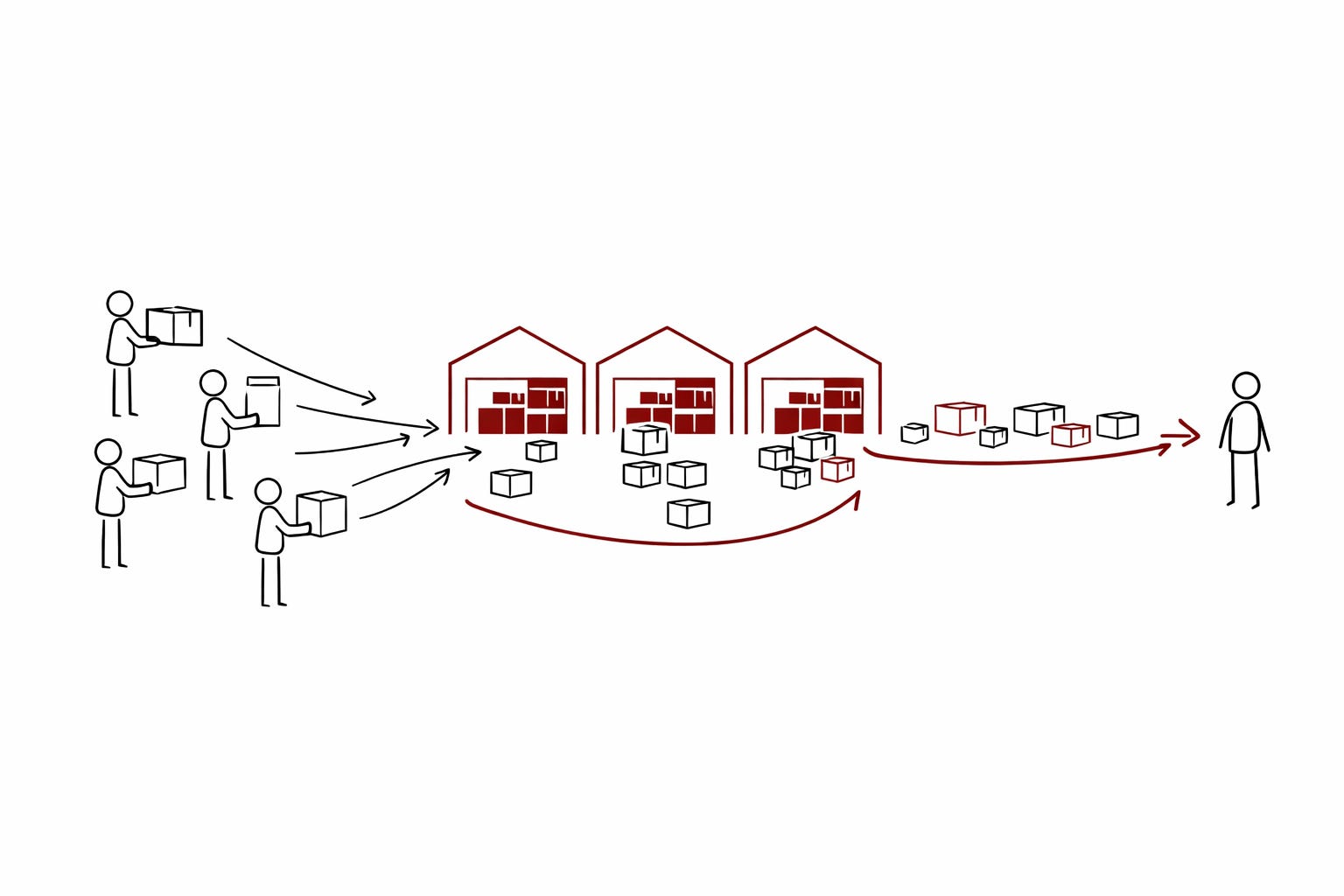
When third-party sellers enter through Rocket Growth, their inventory is not simply added to a catalog and shipped from the seller’s own warehouse with the seller’s own logistics. Instead, their inventory is brought into Coupang’s fulfillment architecture. Their orders are processed through the same operational system that powers Rocket Delivery — the same warehouses, the same delivery network, the same return handling, the same customer service logic.
The consequence is significant: third-party expansion does not weaken the execution loop. It reinforces it.
This is the opposite of what happens in most marketplace growth. In a typical marketplace, adding more sellers creates more operational variance. In Coupang’s structure, adding more sellers through Rocket Growth creates more operational density inside the same execution layer.
More inventory flowing through the same network means better route optimization, better warehouse utilization, better demand forecasting, and better return handling. The system does not become looser as it grows. It becomes thicker.
From Seller Acquisition to Execution Flywheel
This distinction changes the nature of marketplace scaling.
In a conventional marketplace, the flywheel looks like this: more sellers bring more selection, more selection attracts more customers, more customers attract more sellers. That flywheel runs on breadth. It is powerful, but it does not inherently improve the post-checkout experience. The flywheel feeds the top of the funnel without necessarily tightening the bottom.
Coupang’s flywheel has an additional gear.
More sellers entering through Rocket Growth means more inventory integrated into the same logistics network. More integrated inventory means higher execution density. Higher density means better fulfillment performance and more predictable delivery. Better performance means customers trust the system more and reorder more frequently. Higher reorder frequency means more volume flowing through the network. More volume means even higher density.
Each additional seller inside the system is not just a new source of GMV. That seller becomes another contributor to network density. A thicker network can move more packages through the same infrastructure with greater predictability, and greater predictability improves service quality across the board.
This is the point where Rocket Growth stops being a seller acquisition story and becomes an execution flywheel. The loop feeds itself — not just at the demand level, but at the operational level.
The Incentive Structure Is the Strategy
The flywheel becomes self-reinforcing because the incentive structure aligns seller behavior with execution integration.
Products that flow through the Rocket system can reliably meet faster delivery standards. They generate better conversion rates because customers trust the Rocket promise. They earn stronger placement in the platform’s recommendation and search logic. They produce more consistent customer experiences, which leads to fewer complaints and fewer costly exceptions.
Sellers outside the Rocket system may still be visible on the platform. But sellers inside it are more likely to benefit from the full force of Coupang’s execution advantage — better visibility, higher conversion, more repeat purchase.
That incentive draws more merchants into the program. Not because of branding or persuasion alone, but because the economics increasingly reward execution compliance. The market signal is clear: inventory inside the integrated system performs better than inventory outside it.
Over time, this creates a gravitational pull. The more sellers that join, the stronger the network becomes. The stronger the network becomes, the clearer the performance gap between integrated and non-integrated inventory. The clearer the gap, the more rational it becomes for the next seller to join.
The program does not need to force participation. The system rewards it.
Why This Matters More Than It Appears
Traditional marketplace analysis tends to treat first-party retail and third-party seller participation as separate growth levers. First-party is about direct inventory investment, margin control, and category strategy. Third-party is about breadth, take rate, and seller economics.
In Coupang’s case, the more important point is that these layers are more tightly connected than in most platforms.
Through Rocket Growth, third-party participation strengthens the same core infrastructure that first-party retail already depends on. More sellers do not just mean more products for the customer to choose from. They mean a thicker execution network — better routing, better utilization, better recovery, better service across the whole system.
The result is not simply more choice. It is a more reliable system.
And that reliability is precisely where competitive advantage is likely to accumulate as commerce matures. A platform that can grow its catalog while simultaneously strengthening its execution layer occupies a structurally different position than a platform where growth and quality pull against each other.
The Agent Commerce Dimension
This flywheel becomes even more consequential when viewed through the lens of agent commerce — the emerging shift toward AI-driven purchasing.
Human shoppers can tolerate inconsistency. If a product looks compelling enough, if a review is persuasive enough, or if a discount is attractive enough, a human will take a chance on a seller with an uneven track record. Humans evaluate with intuition, emotion, and forgiveness. They can work around messy systems because they are accustomed to doing so.
AI agents will behave differently.
An agent evaluating purchase options on behalf of a customer will not be swayed by visual merchandising, storytelling, or emotional appeals. Its preferences will be shaped by structured signals: Is the item in stock? How fast and reliably can it be delivered? What is the return friction? What is the total confidence level for end-to-end transaction completion?
In that environment, inventory that sits outside the integrated execution layer becomes structurally disadvantaged. Not because it is invisible to the agent, but because it scores lower on the dimensions that matter most — fulfillment certainty, delivery reliability, recovery clarity.
If agent-driven ordering becomes more common, platforms will have strong incentives to prioritize products that can be fulfilled with the highest confidence and the lowest execution risk. On Coupang, that naturally points toward inventory already inside the Rocket system.
Once that preference becomes embedded in recommendation logic, search ranking, or agent routing, seller behavior will shift further. Merchants will not enter Rocket Growth because a sales representative convinced them. They will enter because the system increasingly makes integrated inventory the path of least resistance to commercial success.
Rocket Growth, at that point, is no longer a program. It is a gateway into the dominant execution layer.
What This Reveals About Coupang’s Model
Step back and the picture becomes clearer.
Coupang’s advantage is not simply that it built a closed loop across ordering, fulfillment, delivery, and returns. Many observers understand that much. The deeper advantage — the part that most analysis still misses — is that it created a mechanism to continuously absorb more third-party inventory into that same loop without dissolving operational coherence.
That is much harder to replicate than a fast delivery promise or a large seller base by itself. Many companies can subsidize speed for a period of time. Many marketplaces can recruit sellers with competitive terms. Few can turn seller expansion into a self-reinforcing execution system where each new participant makes the whole network stronger.
The company is not just expanding assortment around a logistics core. It is using seller participation to deepen the closure of the logistics core itself.
That is the real significance of Rocket Growth. It is not a feature. It is not a program. It is the mechanism by which the loop grows — and the reason the advantage may compound rather than plateau.
Whether that compounding continues will depend on many factors: competitive response, regulatory environment, seller economics, and the pace of agent commerce adoption. But the structural logic is clear. And it is a logic that the rest of the commerce industry has not yet fully absorbed.
This article is adapted from K-Commerce Endgame, available on Amazon Kindle.