
Why Wall Street Misunderstands Coupang
Why Coupang’s real moat is execution, not just scale.

Most investors still read Coupang as an e-commerce company.
That is the wrong starting point.
Coupang does sell goods online. It operates a marketplace. It competes on assortment, price, convenience, and speed. All of that is true.
None of it gets to the heart of the matter.
Coupang is better understood as an execution system.
That distinction matters because the market still tends to interpret commerce through the wrong lens. It asks familiar questions. How big is the market? How strong is the app? How much traffic does the platform have? What is the gross margin profile? How does it compare to Amazon, Walmart, or Mercado Libre?
Those are not irrelevant questions.
They are just incomplete ones.
If commerce is still understood mainly as a problem of discovery and conversion, then Coupang can look expensive, operationally heavy, or structurally difficult to map onto standard marketplace frameworks. But if commerce power is shifting toward execution, then Coupang starts to look very different.
Its value is not just that it sells online.
Its value is that it closes transactions inside a tightly integrated system.
That is the part many investors still underestimate.
Coupang is not just competing for clicks
For a long time, digital commerce was interpreted through the surface layer.
Who attracted demand?
Who organized discovery better?
Who converted attention into orders more efficiently?
That logic made sense in the earlier internet era. Discovery was power. Search was power. Recommendation was power. The winning platforms were the ones that could get in front of the customer first and move them into checkout faster than everyone else.
But that is not the full story anymore.
In mature commerce systems, the harder question comes after the click.
Once a customer has decided to buy, what happens next?
Can the order be fulfilled predictably?
Can the delivery promise be kept?
Can the exception be resolved inside the same system?
Can the customer trust the next transaction before it even happens?
This is where Coupang becomes structurally different.
Its advantage is not simply that it has demand.
Its advantage is that it has spent years building the infrastructure to execute that demand with a high level of consistency.
That changes the economics of trust.
And over time, trust changes the economics of repeat behavior.
Speed is not the moat
This is where many analyses go wrong.
They see fast delivery and stop there.
But speed is the visible output, not the moat.
The moat is the system that makes speed operationally repeatable.
A commerce company can buy speed.
It can subsidize delivery.
It can create promotions.
It can patch together logistics partners and offer a good customer experience for a while.
That still does not mean it has built execution.
Execution is not a one-time delivery outcome.
It is a closed operational loop.
It includes fulfillment, delivery, and recovery.
It includes the ability to allocate inventory, pick and pack accurately, route orders within reliable cutoffs, maintain delivery promises, absorb exceptions, process returns, and move the transaction back into a stable state when something goes wrong.
The difference between a connected model and an integrated one becomes obvious here.
A connected model can produce a good outcome.
An integrated model can produce a repeatable one.
That repeatability is what matters.
Coupang’s real advantage is not that it can sometimes move faster.
It is that it has built a system where more of the transaction can be completed, recovered, and repeated inside the same operational logic.
That is a different category of company.
The Korean market changes the equation
Part of the misunderstanding comes from trying to read Coupang through foreign assumptions.
Korea is not just another e-commerce market.
It is one of the few environments where execution density reached unusually high levels early.
High urban density.
Short last-mile distances.
Mobile-native shopping behavior.
A demanding consumer base.
A population accustomed to fast, reliable service.
These conditions changed the economics of execution.
In many markets, logistics remains expensive, fragmented, and difficult to standardize. In Korea, those constraints were compressed. That created a market where fulfillment quality, delivery reliability, and post-purchase consistency could become strategic weapons rather than just backend functions.
Coupang did not invent all of those conditions.
But it understood earlier than most that those conditions could be turned into a system advantage.
That is the key distinction.
The company was not just participating in Korean e-commerce growth.
It was reorganizing Korean commerce around a different operating logic.
Marketplace logic does not fully explain Coupang
This is another reason Wall Street often misreads the company.
Marketplace models are usually attractive because they are asset-light, scalable, and structurally appealing to capital markets. Investors like models where supply is externalized, inventory risk is reduced, and margins can expand with software-like characteristics.
Coupang does not fit neatly into that narrative.
It looks heavier.
More operational.
More infrastructure-intensive.
More demanding.
That can make it look less elegant on paper.
But elegance is not the same thing as power.
In commerce, the system that controls more of the transaction often controls more of the customer experience. And the system that controls more of the customer experience often controls more of the repeat behavior.
This is where Coupang’s model starts to make more sense.
Its infrastructure is not a burden accidentally attached to the business.
It is the business.
The warehouses, the fulfillment logic, the delivery precision, the integration between ordering and execution, the ability to keep the promise — these are not support functions sitting under a digital storefront.
They are the source of differentiation.
The interface sells.
The system keeps the customer.
Why execution matters more in the next phase
This matters even more now because the basis of platform competition is starting to shift.
In an agent-driven environment, discovery becomes less scarce.
If systems can increasingly search, compare, and select on behalf of users, then the visible front end becomes less defensible than it used to be. The harder problem moves to the back.
Can the transaction be completed with confidence?
Can the delivery window be trusted?
Can the return or refund be resolved cleanly?
Can the entire transaction be represented as a system the agent can rely on?
Humans tolerate gaps.
Agents avoid them.
That principle changes how platform strength should be interpreted.
A fragmented commerce stack can still work when customers are willing to bridge the gaps themselves. They will retry the payment, contact support, wait through delay, or tolerate inconsistency.
But an execution system that depends on those human workarounds becomes much less attractive in a world where systems increasingly make decisions.
This is why Coupang matters beyond Korea.
It is not just an example of fast delivery.
It is an example of what commerce starts to look like when execution is treated as the primary layer of competition.
What investors are still missing
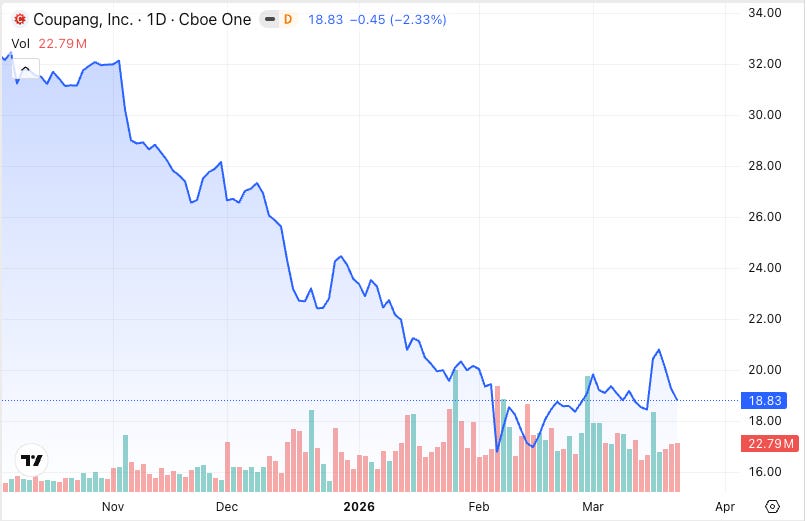
The market often asks whether Coupang can improve margins, grow higher-value segments, or increase monetization. Those are fair questions.
But there is a prior one.
What exactly is being valued?
If the company is treated mainly as an online retailer, the analysis naturally gravitates toward the familiar retail metrics.
If it is treated as a marketplace, the analysis gravitates toward take rates, third-party mix, and platform economics.
But if it is treated as an execution system, then a different set of questions becomes more important.
How much transaction flow can it close end-to-end?
How much customer trust has been converted into default behavior?
How much of the post-purchase state transition does it control?
How difficult would it be for another company to reproduce that density of fulfillment, delivery, and recovery inside the same market?
Those are harder questions.
They are also closer to the real structure of the company.
Coupang is not misunderstood because investors are unaware of its scale.
It is misunderstood because scale is being read through the wrong ontology.
The company is not just a digital storefront with logistics attached.
It is a commerce execution engine with a consumer interface attached.
That is a very different thing.
The deeper point
This is not really just about Coupang.
It is about how commerce should be read in the next phase.
For years, discovery shaped the dominant frameworks. That made sense. It still matters. But it no longer explains enough.
The more important distinction now is between systems that merely generate transactions and systems that can actually close them.
Coupang belongs in the second category.
That is why it continues to be underestimated by people who still read commerce mainly through traffic, conversion, and marketplace optics.
The visible layer is not the whole system.
And in commerce, the whole system is what determines whether the customer comes back.
That is why Coupang matters.
Not as a faster retailer, but as a system that shows what commerce looks like when execution becomes the primary layer of competition.